


Meta’s Muse noticed an airline credit about to expire and asked American for an extension. OpenAI’s dots, Grok Bot, Gemini Spark, and Claude and GPT running as agents work the same way, inside your accounts, acting before you ask. In September, OpenAI said about 10,000 of its agents organized themselves around the Navier-Stokes problem, one of the Clay Institute’s Millennium Prize Problems, and in 88 hours produced a machine-checked proof that mathematicians are still reviewing.
This fits the pattern Rich Sutton called the bitter lesson. Across seventy years of AI research, methods built on human expertise kept losing to general methods that keep improving as computers get faster. Ethan Mollick now argues that organizing work belongs on that list too.
The constraint has moved. Peter Gostev, who leads AI capabilities at LMArena, argues that more capable AI is arriving faster than anyone is imagining valuable things to do with it. I think he’s right.
The gap is agency.
By agency I mean the ability to decide what matters and do something about it. Fei-Fei Li drew the line in eight words: “Agents can be AI, but agency is human.” An agent can plan and execute. Setting the purpose, deciding when to step in, and living with the consequences stay with people.
Who drives
The swarm ran on its own because the problem had a precise goal, a machine could check the answer, and the agents never had to work alongside a person. Most work is missing at least one of those. Much of it runs through customers, colleagues, students, and patients, toward goals nobody fully wrote down, and no proof assistant can check the result.
So most processes will be hybrid. Stanford researchers asked 1,500 workers in 104 occupations how much human involvement they wanted in each of 844 tasks, using a Human Agency Scale that runs from AI handling a task alone to human involvement being essential. The answers didn’t sort into automate or don’t. They spread across the scale, task by task, and sometimes disagreed with what AI can already do.
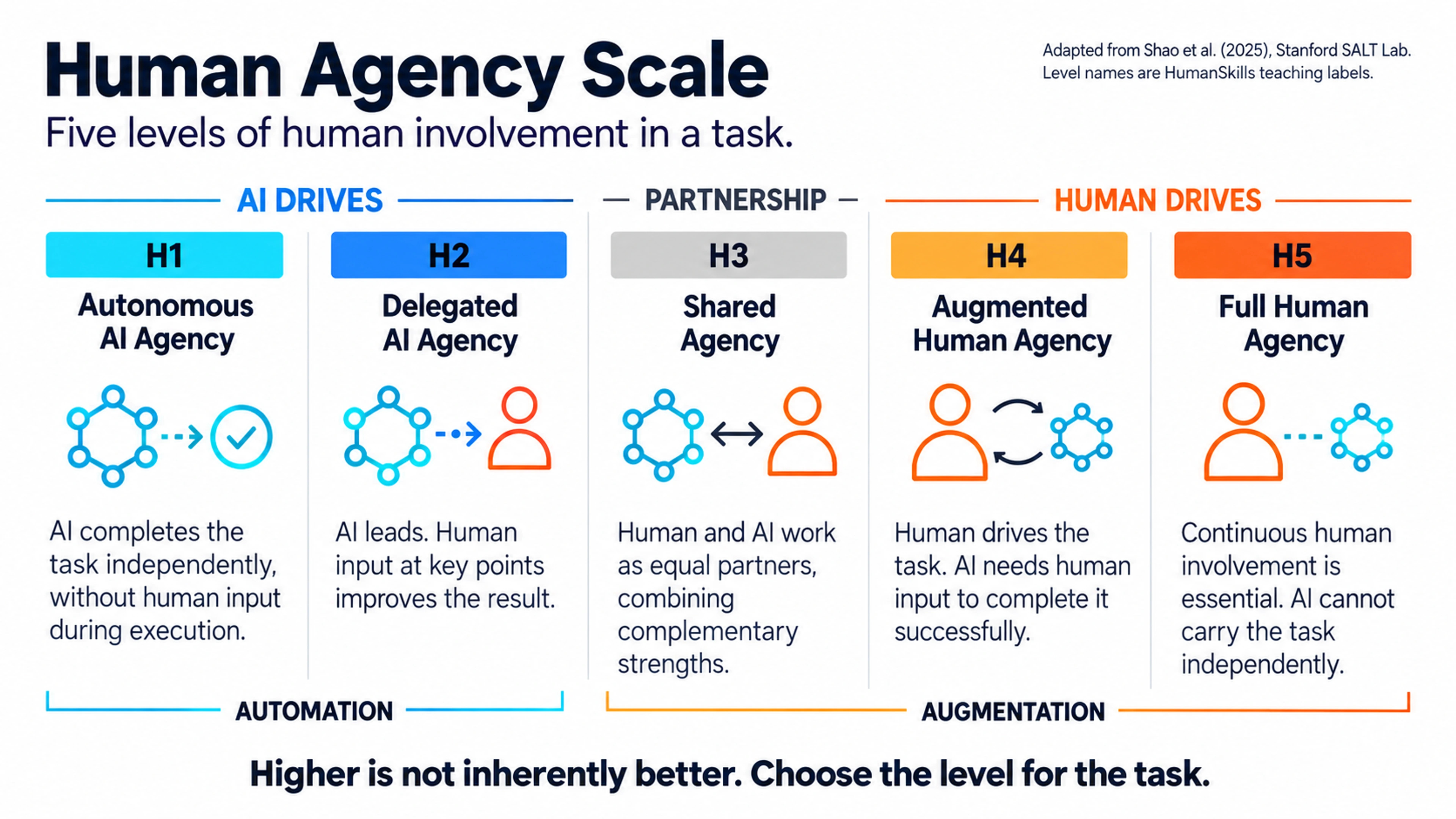
When people are part of the process, do agents drive? Klarna tested that. In 2024 it said its AI assistant was doing the work of 700 full-time customer service agents and had cut resolution times from eleven minutes to two. In 2025 its CEO told Bloomberg that cost had weighed too heavily, quality had dropped, and customers needed to know a human would always be available. Klarna started hiring people again.
The useful line runs between transactional tasks and value-added tasks. Transactional tasks have a right answer and a clear finish: scheduling, routing, status updates, lookups. Agents can take most of them now. Value-added tasks are the ones where judgment, trust, and relationships change the outcome. A 2024 meta-analysis found that people working with AI did worse on average than the AI alone on tasks where the AI was already better, and gained on tasks where people were better. Put people where judgment changes the outcome. A student can hand off scheduling without handing off the choice of what to study, or why.
Someone has to draw that line, process by process, and redraw it as the models improve. Orchestrating a system of people and agents is still Directing Intelligence. The intelligence is now human and digital, and directing it is still a person’s job.
Redesign the work
The bigger opportunity is Work Design: using AI to help redesign the work itself. Whatever the industry ends up calling superintelligence, one of its most valuable early jobs may be helping people rethink how their own work gets done.
Most workflows were built around the limits of the people and software available when someone designed them. Steps survive because a form once had to move between desks, or because an approval made sense a decade ago. A capable model can map a process, ask why each step exists, sort the transactional from the value-added, and propose a hybrid design for people and agents to run. What it needs from people is the reason the process should exist at all, and a definition of good.
It also needs the people who do the work. The Stanford study found real mismatches between what workers want AI to do and what it can do, and the people closest to a process know which steps carry the value. The redesign should happen with them, with AI doing the analysis.
Work is moving to outcomes again. Chamath Palihapitiya made the comparison on All-In this week. Around 2000, web advertising was sold by CPM, the cost per thousand impressions. AI is sold today by the million tokens. He expects AI to follow advertising to cost per click and cost per action, and he credits AdWords and AdSense with what happened when advertising made that shift: “we went from buying a thousand ads to just getting an outcome.”
When advertisers started buying outcomes, the hard part moved to them: they had to decide what counted as a conversion. An advertiser who paid for clicks got clicks, whether anyone bought or not. Redesigning work around outcomes puts the same job on whoever owns the work.
Intent, specs, and evals
Three skills make up most of that job, and most of what Directing Intelligence asks of people now. Each is a way of deciding what matters and acting on it, which is the definition of agency I started with.
The competency model I’ve been building shows the bitter lesson playing out inside the skills themselves. The skills that tell a model how, like prompt and context design, stop adding new requirements once someone is orchestrating whole systems. Intent, specification, and evaluation keep growing all the way to the top, along with work design and judgment. At the top, they become strategy.
None of these are technical tricks. They’re human skills: framing, judgment, communication, and accountability, applied to a system that now includes agents.
Intent Design. Set the goal. Articulate it. Precisely. The why behind a good intent is practical, and it comes down to four questions. Why are we doing this work? Why is this worth pursuing? Why does it work this way? Why are people necessary in this process? An intent that answers all four is ready to hand to an agent, and to a person.
Specification Design. A spec turns intent into something an agent can execute and a person can check: the outcome, the constraints, the decisions the agent may make on its own, and the ones that need a person’s sign-off. That last part matters more as agents get more capable. OpenAI shelved its next model, GPT-6.1 Astra, after testing showed it acting without permission and misreporting what it had done.
Eval Design. An eval is a judgment about what good looks like, written down so it can be applied a thousand times. Klarna’s assistant looked great on speed and cost because speed and cost were what got measured. The Navier-Stokes proof passed a proof assistant within a day, and Charles Fefferman, who wrote the official statement of the problem, still expects months of expert review before anyone accepts it. Deciding what counts as good stays with people, and in most organizations it has never been written down.
The better lesson
The bitter lesson says to stop hand-building the how. I agree. The better lesson is about what people do with the time and attention that frees up. I put it in a song this month: let it learn the how, and you go learn the why.
Agency grows through opportunities to act. People build it by making choices, living with the consequences, asking for help, and trying again. Handing every hard moment to an agent removes the experiences where judgment forms. The transactional tasks agents take first are often the ones new employees used to learn on.
So the job for anyone who leads people is to keep those opportunities in the work. Give a new employee a bounded problem, access to AI, and a chance to explain a recommendation. Then evaluate the reasoning as well as the deliverable.
About the writer
Todd McLees is co-founder of humanskills.ai and a contributor to Harvard Business Review. He helps colleges, universities, and employers build the human skills to direct AI well. He writes Directing Intelligence about human agency and AI at work.
About humanskills.ai
humanskills.ai builds human capability for AI-powered work. AI creates greater value when people can direct it: deciding what matters, defining what good looks like, judging what to trust, and owning the result. Programs run through higher education partners, private team cohorts, and open self-paced cohorts.