



Andrew Yang has a clip making the rounds. In it, he calls the legal profession “the ideal environment for AI,” describes partners giving AI work that used to take junior associates a week, and concludes that firms have no incentive to hire a small army of young lawyers anymore. The video’s graphic shows a six-lawyer boutique in San Francisco that dropped staffing costs 27% after not replacing a departing associate.
It’s a clean story built on a friend’s anecdote, a single data point, and a straight-line extrapolation. In an era where we have access to real data in real time, that’s not good enough.
We are in what I’ve been calling the Agency Economy, a period where intelligence is abundant and human agency is the scarce, high-value contribution. This era calls for a different kind of thinking: precision over anecdote, polarities over single narratives, and an honest reckoning with what’s now possible that wasn’t before. Yang’s clip fails on all three counts.
Precision: What the 2026 data actually shows
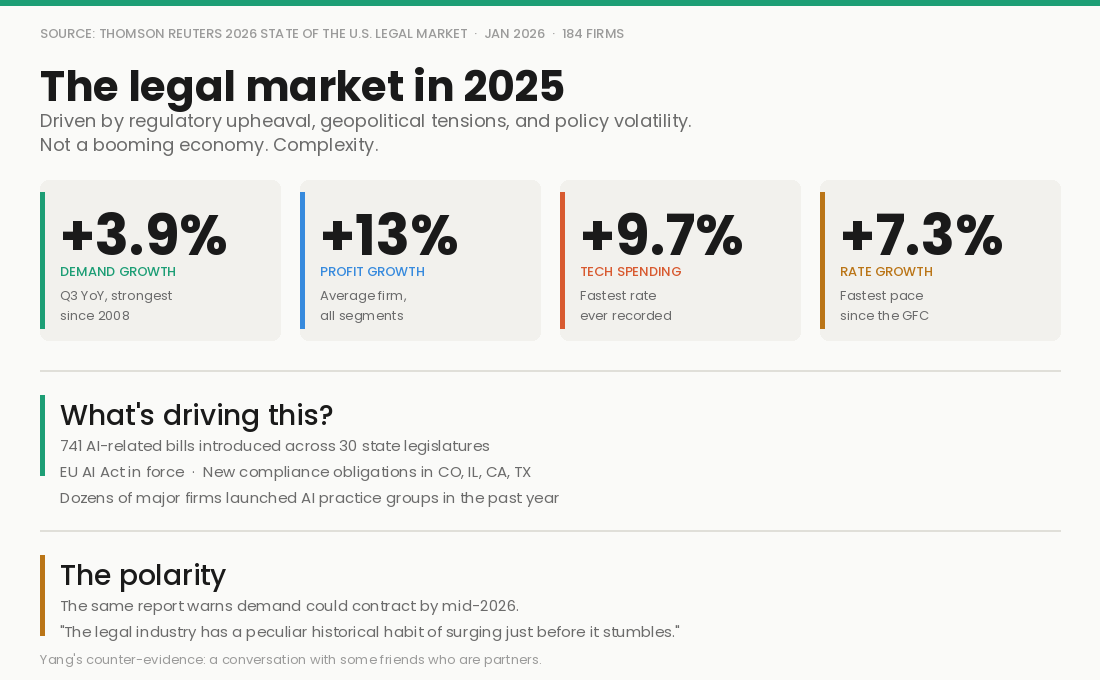
The Thomson Reuters 2026 Report on the State of the U.S. Legal Market (produced with Georgetown Law, released January 2026) is the most current comprehensive picture of the industry. It’s based on financial data from 184 U.S. law firms. Here’s what it shows.
Legal demand grew nearly 2% in 2025, with Q3 reaching 3.9% year-over-year growth. That’s one of the strongest years since the 2008 financial crisis. Billable hours increased 2.5% for the year, hitting 4.4% growth in July. The average firm saw 13% profit growth. Technology spending grew 9.7% and knowledge management spending grew 10.5%, both the fastest rates the industry has likely ever experienced. Rate growth hit 7.3%, the fastest pace since the GFC.
That demand surge, the report makes clear, isn’t driven by a booming economy. It’s driven by chaos: trade wars, regulatory upheaval, geopolitical tensions, and policy volatility. All of which require constant legal work. The firms aren’t growing because business is calm. They’re growing because the world is complicated.
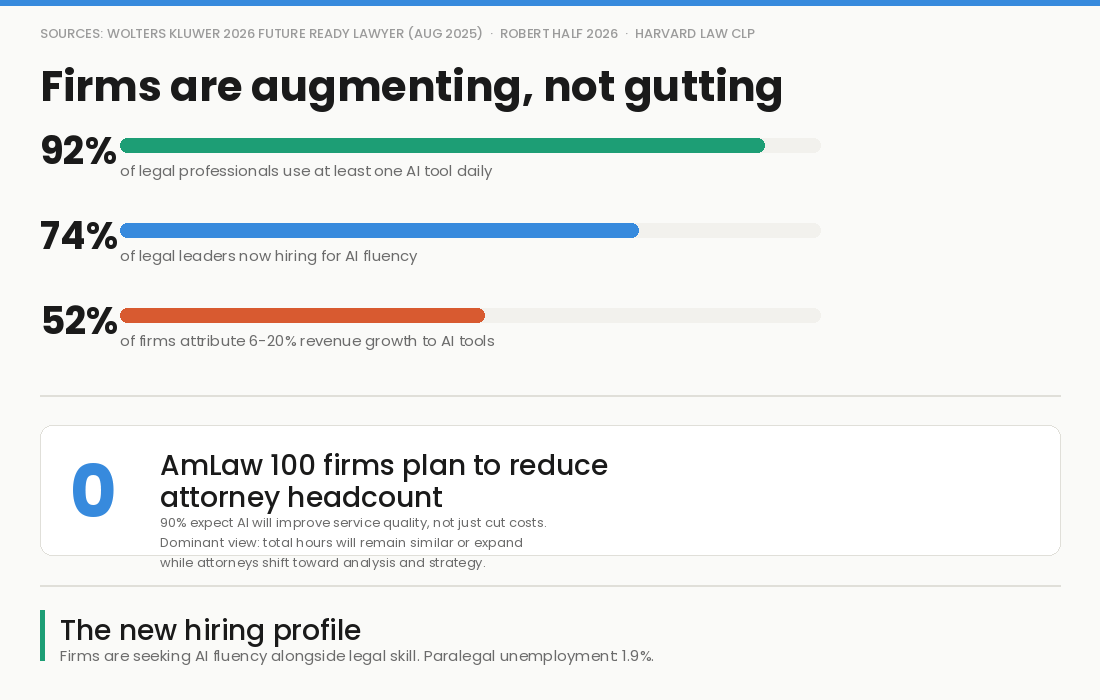
The 2026 Wolters Kluwer Future Ready Lawyer Survey (810 lawyers across the U.S., China, and eight European countries, conducted August 2025) found that 92% of legal professionals now use at least one AI tool daily. Sixty-two percent report saving 6 to 20% of their work week. And 52% of firms attribute a 6 to 20% increase in revenue to those tools. Organizations with defined AI strategies are twice as likely to see revenue growth and 3.5x more likely to realize critical AI benefits.
Robert Half’s 2026 Demand for Skilled Talent report shows 74% of legal leaders say the AI factor alone has made them more likely to bring in staffing help. Firms are hiring, and they’re hiring for AI fluency alongside legal skill. Paralegal unemployment sits at 1.9%, which is barely measurable.
Harvard Law School’s Center on the Legal Profession interviewed COOs and partners at AmLaw 100 firms (published February 2025, but reflecting current deployment strategy). None plan to reduce attorney headcount. Ninety percent expect AI will improve service quality, not just cut costs. The dominant view: total hours worked will remain similar or expand, while attorneys shift toward analysis and strategy.
The above is not a projection or a hope. It’s what the profession measured about itself in 2025 and early 2026. This argument has a shelf life, and I want to be honest about it. If legal-domain hallucination rates drop below 2% across multiple independent benchmarks, if agentic AI systems can handle filing-to-resolution workflows without a licensed attorney verifying the output, or if in-house legal departments start building AI capabilities that bypass outside counsel at scale, the calculus changes. I’ll revisit this in twelve months and see which of those conditions moved. Yang should do the same with his anecdotes.
Why the economics run the other way
The data shows a profession that’s growing while adopting AI at record pace. Yang’s logic says that shouldn’t be happening. So either the data is wrong, or his model is.
His model is wrong. And a piece published today by economists Alex Imas and Soumitra Shukla explains why.
They build on a framework called “O-Ring Automation,” developed by Joshua Gans and Avi Goldfarb. The name comes from the Challenger disaster: a single faulty O-ring brought down the shuttle because every component had to work for any of them to matter. Michael Kremer applied this insight to economics in 1993. When a job requires many tasks done well, and those tasks depend on each other, productivity isn’t additive. It’s multiplicative. One weak link degrades the whole output.
Lawyering is an O-ring job. Research, drafting, client counsel, negotiation, regulatory interpretation, courtroom judgment, relationship management. These tasks multiply against each other. A lawyer who nails the research but misreads the client’s risk tolerance doesn’t produce 85% of a good outcome. They produce a bad one.
This structure changes what happens when you automate part of the job. Imas and Shukla describe something they call the “focus effect.” When AI takes over some tasks in a high-dimensional job (one with many complementary tasks), the worker isn’t left with less to do. They concentrate their time on fewer things. The quality of each remaining task goes up. And because the tasks are multiplicative, those quality gains compound through the entire production function. The worker becomes more productive. Wages rise. The firm doesn’t cut the position. It gets more from it.
This is exactly what the Harvard CLP interviews found. AmLaw 100 firms reporting massive productivity gains on specific tasks. Zero planning to reduce attorney headcount. The economics explain the data.
Contrast that with long-haul trucking, which Imas and Shukla flag as the real canary. A trucker’s job is dominated by one core function: moving the vehicle from A to B. Low-dimensional. If autonomous driving gets reliable on highway routes, there’s no constellation of complementary tasks for the driver to concentrate on. No focus effect. The job goes away. And firms have a stronger incentive to finish automating low-dimensional jobs because eliminating the last task means eliminating the entire wage bill.
Yang treats lawyering as if it were trucking. As if “research and drafting” is the whole job, and automating those means the rest collapses. Law has seven or eight distinct, complementary tasks. Automating two of them doesn’t reduce the need for lawyers. It makes the remaining six more valuable.
There’s a second variable in the Imas and Shukla framework: demand elasticity. When productivity gains lower costs in a market where cheaper prices bring in significantly more buyers, the result isn’t fewer workers. It’s more. Jevons’ paradox: when coal engines got more efficient, coal consumption didn’t drop. It exploded, because efficiency opened applications that were previously too expensive.
Legal demand right now is about as elastic as it gets. Which brings us to what AI is actually creating.
Polarities: Different firms will make different choices
The Thomson Reuters report includes a warning that’s just as important as the growth numbers. The legal industry, it notes, has “a peculiar historical habit of surging just before it stumbles.” Similar demand explosions preceded both the 2008 financial crisis and the 2022 inflation crunch. Forecasts in the report point toward slowing growth by mid-2026, with Q3 potentially dipping into contraction.
This matters because it’s the truth Yang is circling without quite reaching. Some firms will contract. Some practice areas will soften. Some junior roles that existed primarily to absorb low-value document work will, in fact, be reshaped or reduced.
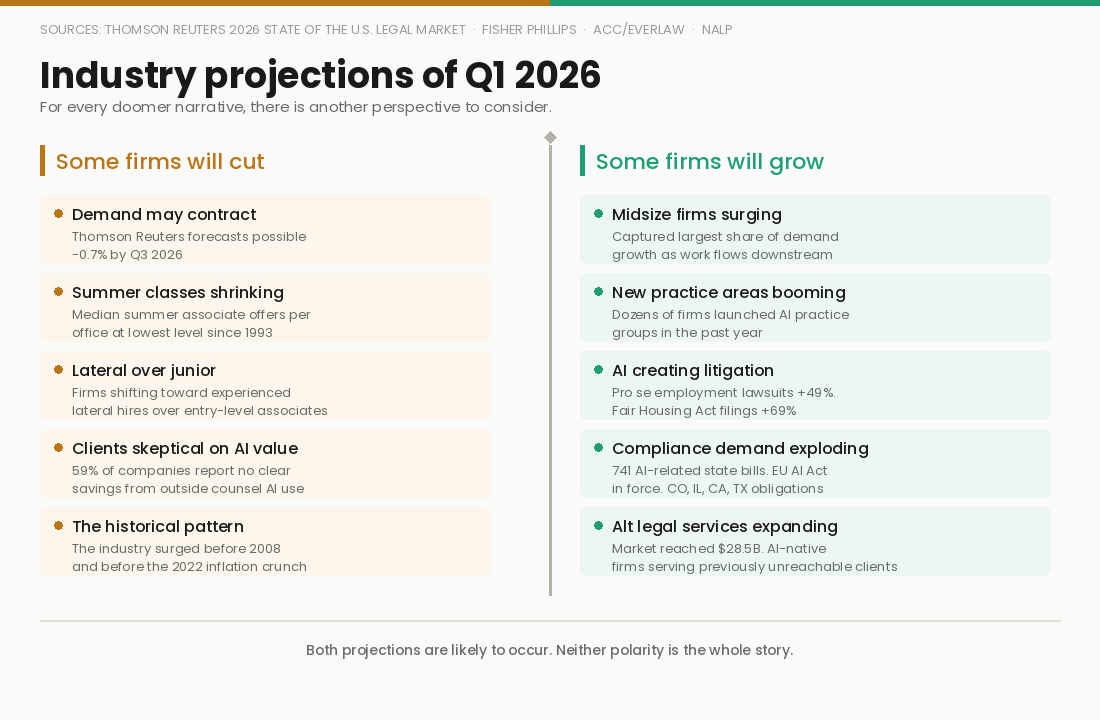
And simultaneously, other firms are growing. Midsize firms captured the largest share of demand growth in 2025 as corporate legal departments pushed routine work downstream from Am Law 100 firms. New AI practice groups are launching across major firms. The alternative legal services market reached $28.5 billion. Pro se employment lawsuits surged 49% in 2025, creating new defense work. Fair Housing Act filings jumped 69%. Courts are drowning in AI-generated motions that require human lawyers to counter. Nippon Life Insurance is suing OpenAI after a single AI-armed litigant generated $300,000 in defense costs.
And there are 741 AI-related bills introduced across 30 state legislatures as of January 2026. The EU AI Act is in force. Colorado, Illinois, California, and Texas all have new AI compliance obligations. Meanwhile the White House just unveiled their National AI Legislative Framework. Every company deploying AI now needs lawyers who understand the rules.
For every doomed narrative, there is a different polarity. Yang tells one side. The data shows both.
The polarity that matters most: some firms will see AI as a reason to cut. Others will see it as the growth opportunity of a generation. Both will be right about their own situation. Neither is right about the profession.
Possibilities: The too-hard, too-big era is over
This is what makes the current moment genuinely different from every prior technology cycle in legal services. The Thomson Reuters report describes “an almost absurd tension” where firms deploy technology that accomplishes in minutes what once took hours, then try to bill for it by the hour. Ninety percent of legal dollars still flow through standard hourly billing.
That tension isn’t a crisis. It’s an opening.
Harvey, the legal AI company valued at $8 billion and used by a majority of the Am Law top 10, reports a 0.2% hallucination rate on its internal BigLaw Bench benchmark. Its architecture uses domain-specific models, multi-layer claim verification, and real-time Shepardization through LexisNexis. A&O Shearman, Harvey’s flagship client, has over 1,000 lawyers using the platform daily, saving two to three hours per staff member per week with notable reductions in contract review time.
That’s a tool that makes things possible that weren’t before. Contract analysis across forty NDAs at once. Regulatory compliance monitoring that tracks changes in real time. Due diligence workflows that compress weeks into days.
The “too expensive to pursue” cases can now be pursued. The “too many documents to review” problems can now be reviewed. The access-to-justice gap (more than 50 million low-income Americans receive inadequate legal help for 92% of civil legal problems) can start to close. The UK’s Solicitors Regulation Authority approved Garfield.Law as the first firm authorized to deliver legal services entirely through AI, targeting small claims at per-document pricing.
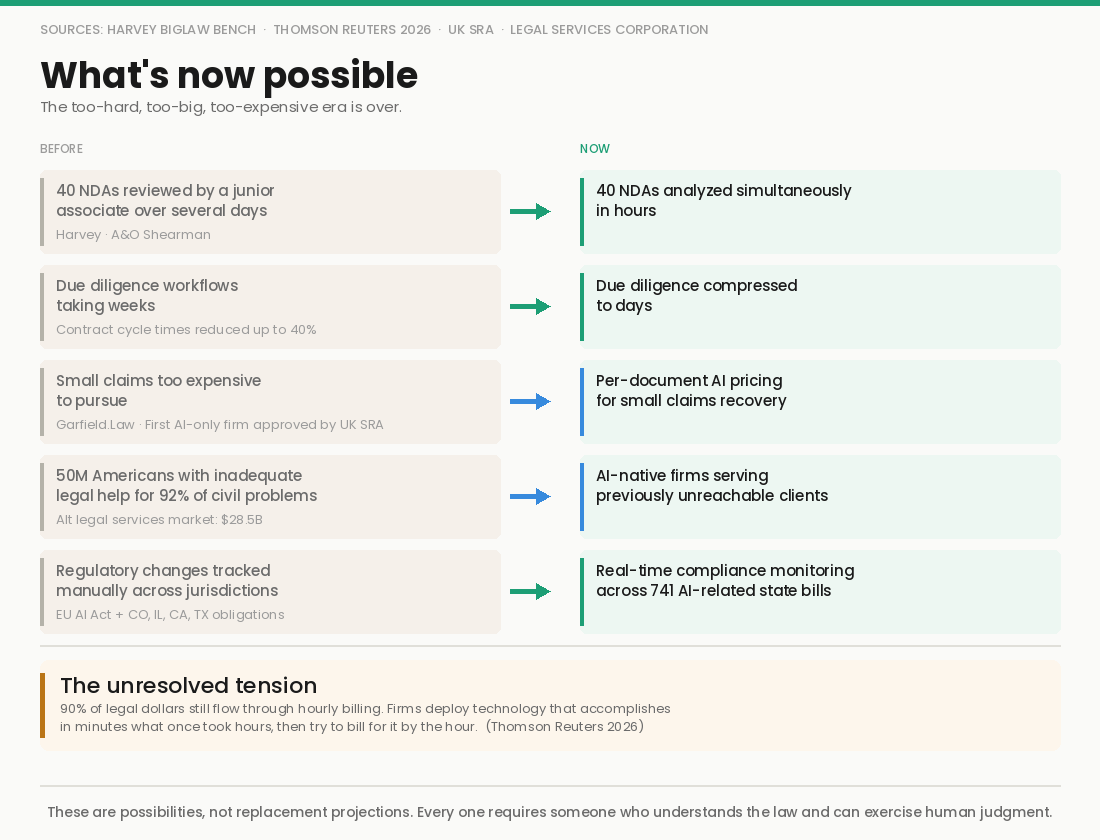
These are possibilities, not replacements. Every one of them requires someone who understands the law, the client’s situation, and the limits of the tool. Harvey’s own clients still validate everything the system produces. The possibility isn’t “no more lawyers.” It’s “lawyers can now do things that were previously impossible.”
People: Human agency is the scarce resource
The hallucination numbers tell a story, but not the one most commentators draw from them.
Harvey’s 0.2% is self-reported on its own benchmark. The broader domain-specific data (from the Suprmind 2026 benchmarking report, updated in March 2026) shows legal-specific hallucination rates averaging 18.7% across leading models. On the AA-Omniscience evaluation, Gemini 3 Pro showed an 88% hallucination rate: when it doesn’t know an answer, it fabricates one nearly nine times out of ten rather than saying so. The newest reasoning models, the ones marketed as most intelligent, are measurably worse at sticking to provided facts. Every reasoning model tested on Vectara’s enterprise-length benchmark exceeded 10% hallucination.
A 2025 mathematical proof confirmed that hallucinations can’t be fully eliminated under current architectures. OpenAI published research in 2026 acknowledging that training processes inadvertently teach models to confabulate rather than abstain.
Here’s the principle that matters: as errors get rarer, they get harder to catch. A model that hallucinates 30% of the time produces errors anyone can spot. A model that hallucinates 2% of the time produces errors that require genuine expertise to identify. The remaining mistakes are the subtle ones: a citation that exists but doesn’t support the proposition, a statute from the wrong jurisdiction, an analysis that tracks logically but misses a recent reversal.
Risk tolerance has to match the context. Summarizing a contract for internal planning? Low stakes, let the tool rip with a quick check. Filing a brief with a federal court? Advising a client on whether to accept a settlement? Submitting regulatory compliance documentation? The cost of a single confident error in those contexts is six or seven figures.
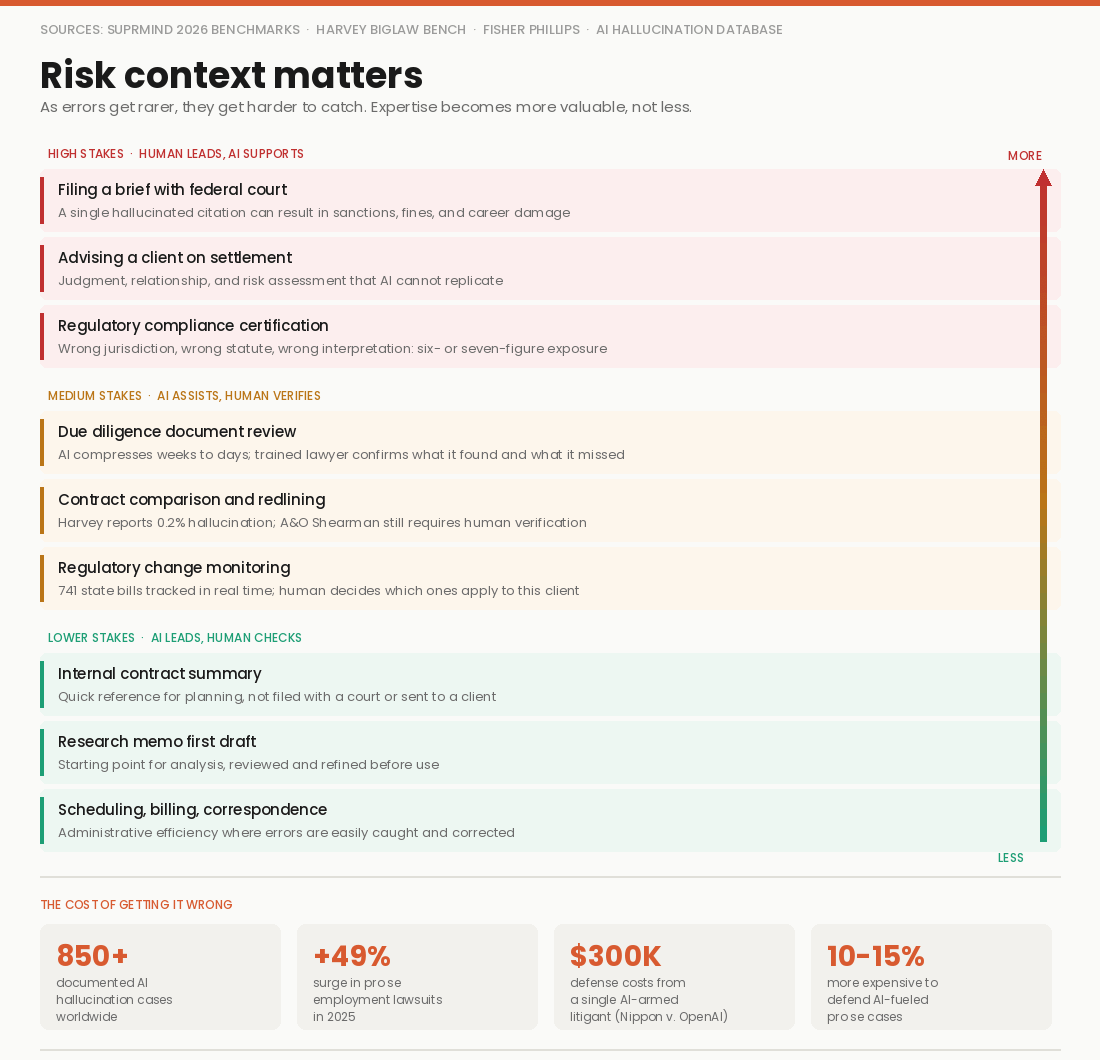
An assistant US attorney in North Carolina recently resigned over AI-fabricated quotes in a brief. Butler Snow faced judicial scrutiny for filings with fabricated citations. The AI hallucination cases database now tracks over 850 documented instances worldwide.
“Vibe lawyering” (using AI to practice law without legal training) is already producing expensive wreckage. Fisher Phillips reports defending AI-fueled pro se cases costs 10 to 15% more than typical claims, because the litigants can generate unlimited motions in minutes. One litigant sent over 300 AI-generated accusatory emails to opposing counsel. Another produced a 456-page appellate brief recycling motions already flagged for hallucinated citations.
Someone has to respond to all of that. Someone has to verify Harvey’s output before it goes to a client. Someone has to know whether the AI’s analysis of Colorado’s new AI Act applies to a company headquartered in Texas with EU operations. Someone has to sit across from a client and exercise judgment about what to do next.
That someone is a person with legal training, professional judgment, and the agency to direct intelligence rather than be directed by it.
The real question Yang should be asking
The ABA Task Force on Law and AI noted in its December 2025 Year 2 report that professional attitudes have shifted from whether to use AI to how to use it responsibly and effectively. Their assessment of the current technology: it won’t replace lawyers, eliminate the need for negotiation, take depositions, or try cases.
That framing is closer to the truth, but it still undersells what’s happening. The better question isn’t “will AI replace young lawyers?” It’s “what does a young lawyer need to be in 2026?”
The answer is: someone who arrives AI-fluent, understands when to trust a tool and when to question it, spends less time on mechanical tasks and more time developing the judgment that separates competent from excellent. Someone whose floor of competence is higher because AI handles the basics, and whose ceiling is higher because they started learning strategy and client work in year one instead of year four.
That’s a different kind of junior lawyer. Not a smaller one. Not an eliminated one.
Different firms will make different choices. The Thomson Reuters report is honest about the instability ahead. Some firms will cut. Some will grow. Some boutiques will run lean. Some midsize firms will surge. The profession is large enough to contain all of these polarities.
But the blanket conclusion that AI means “no more young lawyers” misreads the market (which grew nearly 2% in 2025 and is investing at record rates), misunderstands the technology (which requires trained humans to verify, direct, and apply), and ignores the new legal demand AI itself is generating (741 state bills, cascading compliance obligations, an explosion of AI-related litigation).
Intelligence is abundant. Agency is scarce. The firms that understand the difference will build the future of the profession. The ones that don’t will spend it reacting to other people’s narratives.