


Directing Intelligence Digest | November 14, 2026
In the jobs where AI can do the most work, people aren’t being laid off any faster. They’re waiting longer to get hired. Two economists at the Federal Reserve Bank of Cleveland estimate that in the most AI-exposed occupations, the average stretch of unemployment has grown from about 10.5 weeks to more than 13, and the gap is widest for workers 23 to 30. The first rung of a career is getting harder to reach, just as students hand that rung’s practice work to AI.
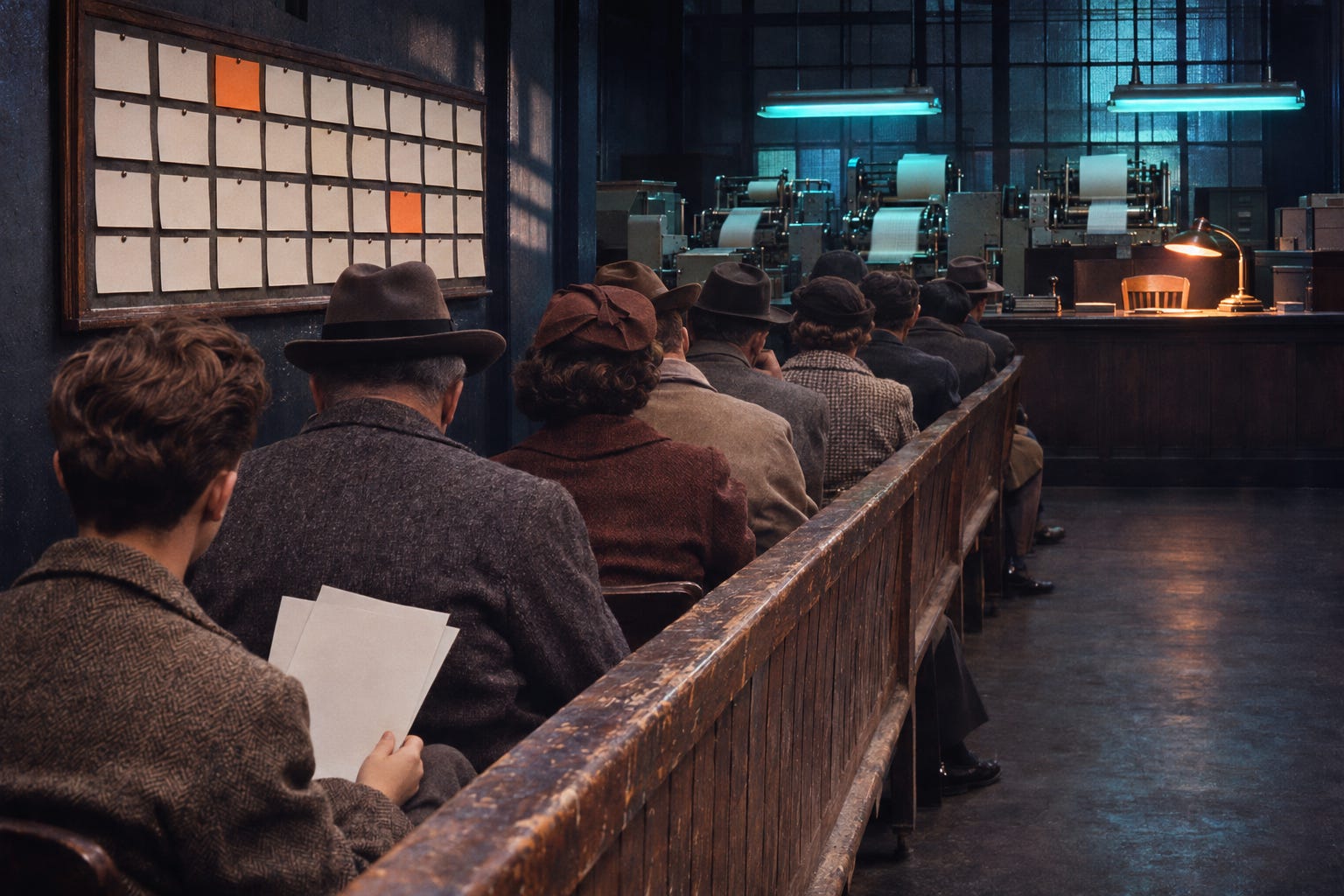
Today’s video moves from a 1950s employment office with one long waiting bench into a college lab where every test bench is lit. Watch it asking: in your organization, who is still doing the first-job work where judgment gets learned?
The short version
The hiring door is the problem: in the most AI-exposed occupations, unemployment rose about 1 percentage point more than in the least exposed since generative AI spread, because job-finding fell, not because layoffs rose. (Cleveland Fed, Nov 9)
Younger workers feel it most: for workers 23 to 30, moving from the least to the most exposed jobs adds about 2 points of predicted unemployment; for 45 to 54, at most 1. (Same source)
Students skipped the check: in a third-year testing course at Ontario Tech, 90% of students asked the AI to write the whole test, and only 24% asked it to check the tests. (arXiv 2611.14664, Nov 10)
A Fed governor on who gains: Michael Barr says work that needs judgment, coordination and relationships is more likely to be helped by AI than replaced. (Federal Reserve, Nov 12)
Here’s AI at work: the people inside are fine, and the people trying to get in are waiting
The research. Alexander Cline and Barış Kaymak of the Federal Reserve Bank of Cleveland used the Current Population Survey, the government’s monthly survey of about 60,000 households, to follow workers aged 23 to 54 from one month to the next. They sorted 923 occupations into 20 equal groups by how much of the work AI can do, using three different exposure measures, and compared 2015 to 2019 with the period after generative AI spread. Cleveland Fed Economic Commentary 2026-26.
What it finds. Unemployment rose about 1 percentage point more in the most exposed occupations than in the least exposed. The reason is hiring. Job-finding rates, the share of unemployed people who land a job in a given month, fell about 6 points more in the most exposed groups, against a typical monthly rate of about 34%, which the authors estimate stretches the average spell of unemployment from about 10.5 weeks to more than 13. Rates of leaving or losing a job show no consistent pattern. In their words, it looks like a “no hire, no fire” market: “For those on the outside trying to get in, particularly younger workers entering the labor market for the first time, the door appears to be harder to open.”
How it fits. It sits uneasily beside Stripe economist Ernie Tedeschi’s analysis from Thursday (a quick hit here yesterday), which found remote work tracks the dip in young graduates’ employment far more than AI exposure does. Different data and different outcomes, so neither settles it. Within the Cleveland Fed paper, the measure built from real AI usage shows a flatter slope, which the authors link to Anthropic’s estimate that about 57% of usage helps people do the task rather than doing it for them. Fed Governor Michael Barr said at Yale on Thursday that there has been “relatively little displacement” so far, with signs of substitution “especially for younger, less-experienced workers.”
Limits. An early look at a pattern in survey data, so it can’t show cause and effect. Unemployed people are sorted by their last job, so true first-time job seekers are missed. The authors say the real effect may be stronger than what they measure.
What to watch: whether the gap widens in coming months, and which occupations drive it.
Read it: Job Finding and Unemployment in the Age of AI (Cleveland Fed) | On X: Ronnie Chatterji on the paper
Who’s Directing? I run my own team of AI agents, so I read this one as a manager. If I ran an operations team, before I let a junior opening go unfilled I’d write down what that seat taught the people who held it, and decide on purpose who learns it now.
Now, here’s what’s happening in learning: students hand off the rep the course was built for
The research. Daniel Hinbest, Jeremy Bradbury and Michael Miljanovic of Ontario Tech University in Canada watched what students do with an AI coding assistant when nobody tells them how to use it. Students in a third-year software quality course wrote unit tests, small pieces of code that check whether other code works, with the Continue assistant running GPT-4o or GPT-5. Of 32 volunteers, 21 had usable data. arXiv 2611.14664.
What it finds. In the first task, 90% asked the AI to write the test code, and 76% of exchanges were one-shot: a single request with no follow-up. Only 24% asked the AI to check the tests. In the second task, 84% asked for complete code and 5% asked for a check. The authors’ conclusion: the students shifted “from learning how to write effective unit tests to simply completing the task.”

How it fits. A larger trial points the same way. In Nature Human Behaviour last month, 487 management consultants given ChatGPT and training beat a control group on data science tasks outside their skills, then were no better at technical questions once the tool was gone. The authors called AI an “exoskeleton.”
Limits. Twenty-one students, one course, volunteers, and no learning results yet; the non-AI comparison is still to come.
What to watch: the authors’ promised comparison with the non-AI tasks.
Read it: Outcome Over Learning? (arXiv) | Wiles et al., Nature Human Behaviour | On X: ComputerPapers on the study
Who’s Directing? If I were a community college dean, I’d ask every program that allows AI on assignments to grade the checking along with the result. Students would hand in what they asked the AI, what came back, and what they changed, because checking the AI’s work is the step these students skipped.
Quick hits
A Fed governor puts AI and inequality on the record. In a Yale speech on Thursday, Governor Michael Barr noted labor’s share of U.S. income hit a record low of 52.8% in the second quarter of 2026. He said AI “could be what some researchers call capital-biased innovation,” meaning the returns go mainly to owners of capital rather than to workers, and called for investment now in worker training and connecting workers to new jobs. Views are his own. Federal Reserve, Nov 12 | On X: Ronnie Chatterji on the speech

Triangulation: signal and noise
Signal. A national labor survey, a classroom log study and a randomized trial meet at the same place: the first rung. Employers are slower to hire into it, and students are handing its practice work to AI. That’s where Cognitive Coverage matters most, keeping people doing the thinking the work depends on, so there are still people who can direct the intelligence later.
Noise. The Cleveland Fed numbers are early and associational; the Ontario Tech study is 21 students with no learning measure; the consultant trial is about short-term skill, not careers.
What I’d do. Keep some entry-level seats open on purpose and write down what they teach. In class, grade the check along with the answer.
Until tomorrow, that’s the intelligence. How it’s directed is up to you.
Todd