


Directing Intelligence Digest | November 5, 2026
Today’s video covers two stories: a KIT and IBM Research model of skill eroding while output looks fine, and a Google Research and NFTE trial of AI built to make students practice. Watch it asking one question: in your organization, who’s still doing the reps?
The short version
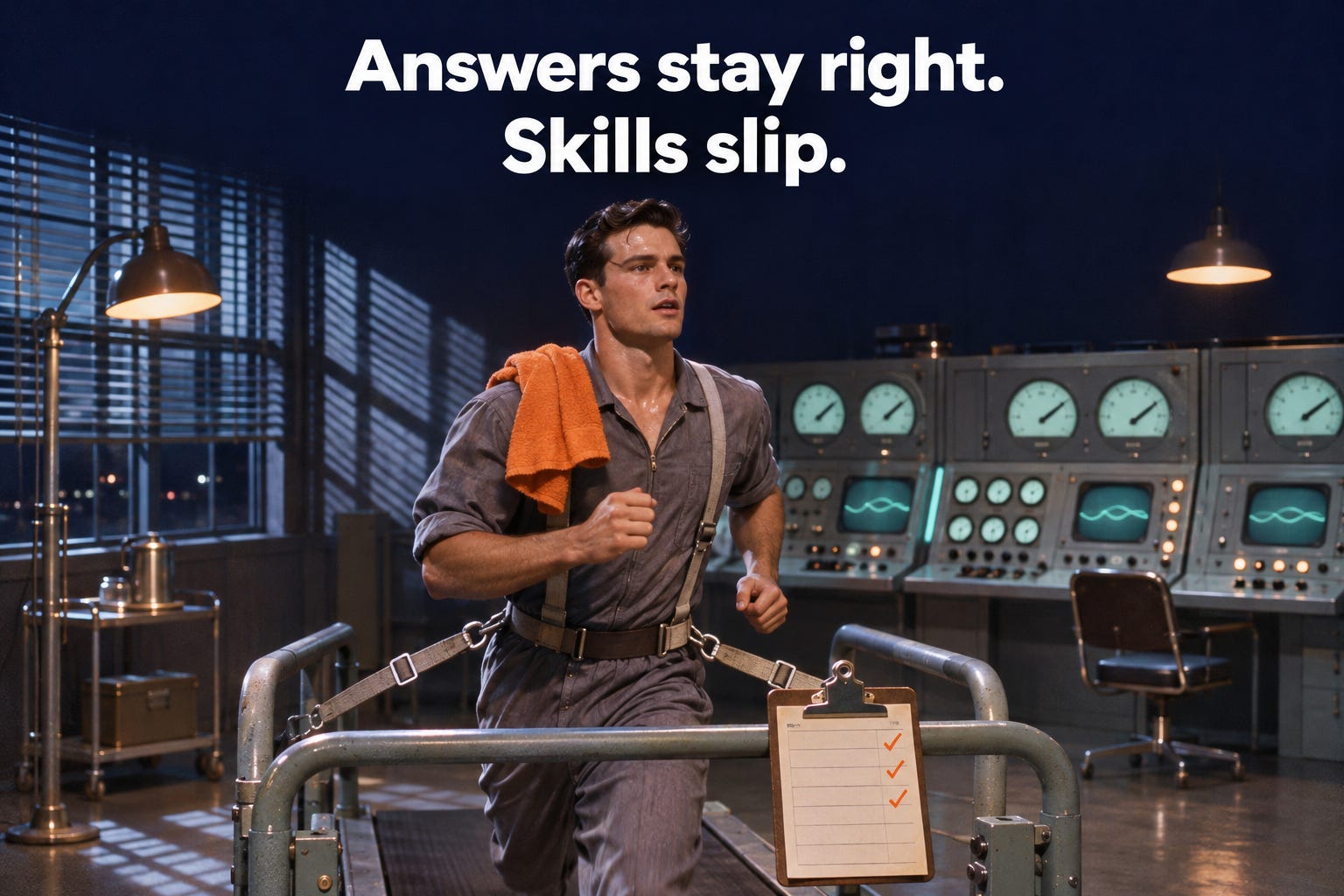
Hidden deskilling: a new KIT and IBM Research model shows answers can stay right while skill slips, and standard reliance scores can call that appropriate. (arXiv)
Lock-in: an Oxford model finds a long stretch of cheap AI can leave a population dependent after the advantage fades. (arXiv)
Gartner: 23% of 1,303 functional leaders cut headcount due to AI; 17% added. (Gartner)
MIT: AI lifted worker accuracy 21 points, yet workers gave it about a quarter of its rational weight. (arXiv)
Google and NFTE: push-back AI teammates, +7.1 points on business plans; students who skipped practice saw no gain. (arXiv)
UChicago: tech-free Core classrooms, Claude for every student, and a no-AI writing course. (Chicago Maroon)
WORK: The skill loss you can’t see in the output
The research. Karlsruhe Institute of Technology researchers, with Wei Sun of IBM Research, built a theoretical model: on each task a worker accepts the AI’s answer or solves it alone, and skill grows or decays with practice.
What it finds. Novices get trapped and experts deskill while output accuracy holds at the AI’s level. “Appropriate reliance” scores can rate those acceptances as fine. Paying for effort restores reliance but not learning; paying for correct unaided answers does, and pays novices most.
How it fits. Oxford’s Renaud Lambiotte, posted a day earlier, models lock-in: same average pay can hide users at skill 0.12 next to non-users at 0.92. Clinically, endoscopists who’d used AI detected fewer adenomas once it was withdrawn.
Limits. Illustrative parameters, no field data.
What to watch: employers reporting unaided accuracy.
Read it: KIT and IBM paper | Oxford paper

Who’s Directing? I’d add one number to every AI dashboard I sign off on: what the team gets right with the tool switched off. Then I’d put practice on the calendar like any other work.
WORK: Gartner says freed time leaks away
The research. A Gartner survey of 1,303 senior functional leaders, January to April 2026 (press release; full report for clients).
What it finds. “Twenty-three percent of functional leaders reported a reduction in headcount due to AI, while 17% reported an increase,” says analyst Grace Gstalder. Her line: “AI-generated capacity is a resource, not a return.” Gartner’s steps: name priority outcomes for freed time, build redeployment into performance management, tie gains to financial results.
Limits. Advisory-firm survey; only the press summary is public.
What to watch: whether “redeployment” includes the practice time the KIT model says skills need.
Read it: Gartner release
Who’s Directing? If your AI business case counts freed hours, I’d ask where those hours go. Some of them should buy back practice.
WORK: Workers underuse good AI advice
The research. MIT researchers including Asuman Ozdaglar and Daniel Huttenlocher model how a worker combines her own evidence with an AI’s, then test it on ChatBench data.
What it finds. AI raised accuracy 21 points, yet workers applied about a quarter of the Bayes-rational weight. If a worker ignores how much her evidence overlaps the AI’s, a stronger AI can make her less accurate.
Limits. Lab benchmark; I’m working from the abstract.
What to watch: trust calibration in onboarding.
Read it: arXiv paper
Who’s Directing? Teach people to ask what the AI knows that they don’t. That’s the judgment worth training.
LEARNING: AI built to argue made students practice
The research. Google Research and the Network for Teaching Entrepreneurship randomized 52 middle and high school students at four summer BizCamps. AI teammates pushed back, pitched flawed ideas and stated false claims to test whether students checked. Comparison students did the same tasks on worksheets and could use ordinary AI tools. Google tested its own platform.
What it finds. Final business plans scored 67.6% vs 60.5% (+7.1 points), graded by teachers and judges on NFTE rubrics written before the study. Ten students with access completed zero tasks and averaged 59.3%.
How it fits. It mirrors the KIT model: gains followed practice. UChicago, below, protects practice by design.
Limits. Small, short, vendor-run; 25.5% didn’t enjoy it at all; the dose pattern isn’t randomized.
What to watch: a larger, independent replication.
Read it: arXiv paper

Who’s Directing? If I were piloting AI in a course, I’d judge it by one log: did students actually practice? Usage minutes wouldn’t count.
LEARNING: UChicago gives everyone Claude and protects the reps
The story. The Chicago Maroon reports that the University of Chicago has banned technology from humanities and social sciences Core classrooms, even as every student now has access to Anthropic’s Claude suite. A summer memo called the social sciences Core “best understood as a pedagogical setting without AI.” The new ICA writing course, taken by about 70% of first-years and required from 2027-28, bars generative AI from producing, revising or evaluating coursework.
What changed for people. Instructors moved to in-class exams, paper notes and discussion before writing. “The hum Core and sosc Core are training the muscle of your mind,” says senior instructional professor Samantha Fenno. One student called all-in-class essays “going a bit too far.”
Limits. Student-newspaper reporting; no outcome data yet.
What to watch: whether ICA reports writing gains.
Read it: Chicago Maroon, Nov 2
Who’s Directing? The part I’d copy is the pairing: give everyone the tool, then protect the rooms where the skill gets built.
Quick hits from X
Addy Osmani (essay, not research) maps a slide from offloading to “cognitive surrender” and suggests: “Once a week, write a bit of code without an agent.” It lands on the same prescription as the KIT paper, from a practitioner. On X: Osmani’s article
Worth a listen
Nothing cleared the bar today. This week’s podcasts I checked were product talk, not research or deployment evidence.
Triangulation: signal and noise
Signal. Two independent models, a related October paper and a clinical study point the same way: reliance can hide skill loss. Google’s trial adds a dose pattern, and UChicago is already designing for it.
Noise. None of the models are calibrated against workers yet, and the strongest learning result comes from the vendor.
My read. Measure unaided skill and budget practice now; it’s cheap insurance.
Until tomorrow, that’s the intelligence. How it’s directed is up to you.
Todd
Sources
Diener et al., “Today’s Work, Tomorrow’s Workforce,” arXiv 2611.06346
Lambiotte, “Modelling lock-in of AI adoption through skill erosion,” arXiv 2611.04886
Lancet Gastroenterology & Hepatology, endoscopist deskilling study, 2025
Google Research and NFTE, “Improving Entrepreneurial Skills by Practicing with AI,” arXiv 2611.02016
Chicago Maroon, “The Value of the Humanities Is the Human,” Nov 2, 2026
Addy Osmani on X, “Critical thinking when agents do the work”