



The Burning Glass Institute just released a report that caught my attention. They analyzed millions of job postings from before and after ChatGPT launched, looking for evidence of how AI is actually changing work. Not predictions. Not projections. Real data about what employers are asking for.
What they found surprised me. And it should change how we talk about this.
The Finding That Matters
You’ve heard the stories about AI and jobs. AI will automate work away and we’re all in trouble. AI will make us more productive and everything will be fine. AI will eliminate some jobs but create new ones we can’t predict yet.
The Burning Glass research suggests all of these stories miss what’s actually happening right now, in existing roles.
Automation and augmentation aren’t happening to different jobs. They’re happening to the same jobs. At the same time.
Think about what that means. Project managers aren’t disappearing. But the skills employers want from project managers are shifting. Demand for spreadsheet and presentation work is softening. Demand for budgeting, scheduling, and strategic thinking is growing. The job title stays. The work inside it changes.
Same pattern with sales roles. The administrative and operations tasks are fading. Relationship management and prospecting matter more than before.
Look at this chart. Each dot is a job. The further right a dot sits, the more of that job’s tasks AI can take over. The higher up a dot sits, the more AI can amplify what’s left.
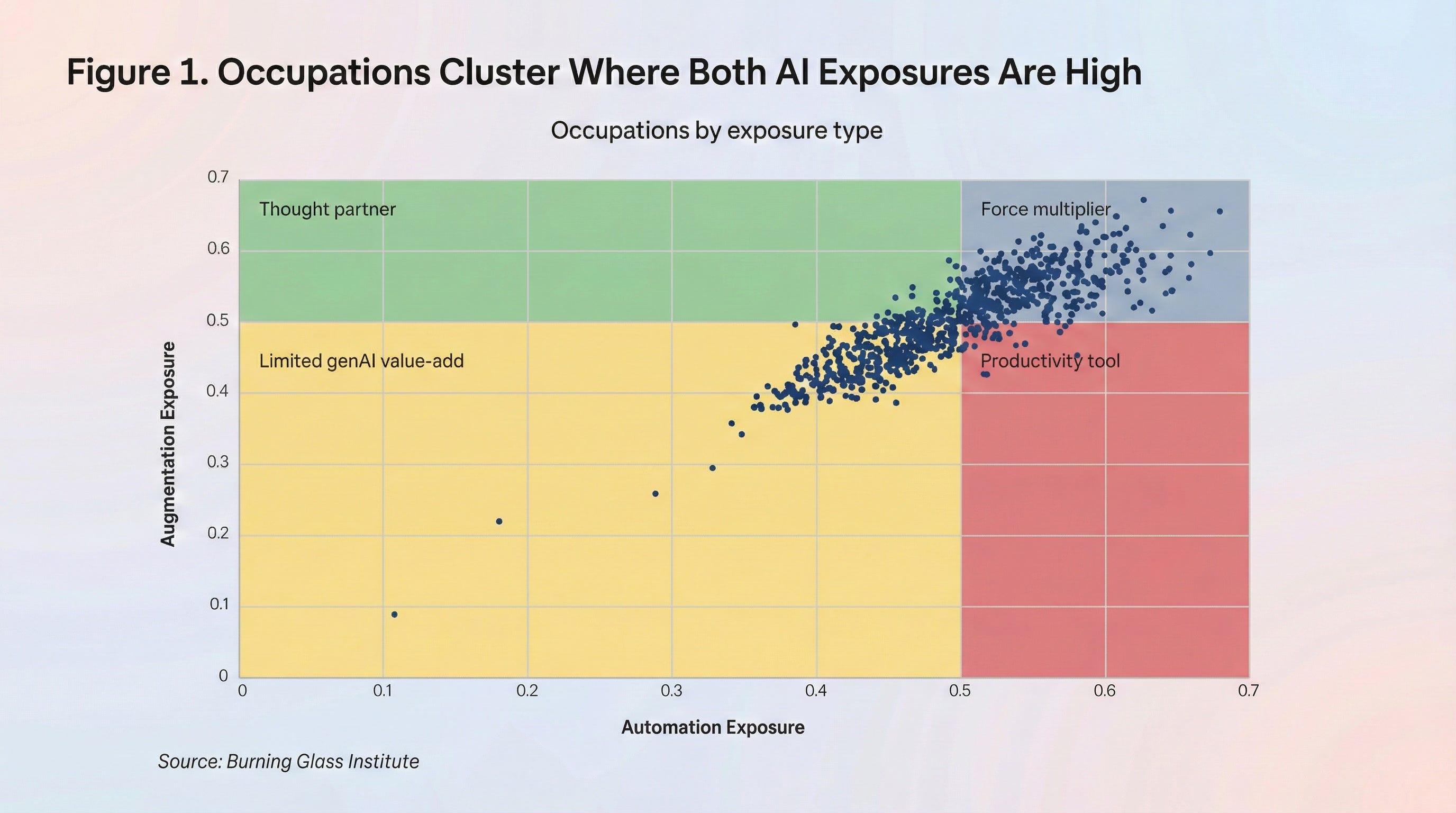
If some jobs were “automation jobs” and others were “augmentation jobs,” you’d see dots spread across the chart. Some jobs in the bottom-right getting automated. Other jobs in the top-left getting enhanced. Different jobs in different places.
That’s not what the data shows. The dots cluster along a diagonal. The jobs most exposed to automation are the same jobs most exposed to augmentation. Burning Glass calls these “force multiplier” roles: AI both replaces some tasks and amplifies others, in the same job.
The researchers also tracked which skills are growing and shrinking in job postings since ChatGPT launched.
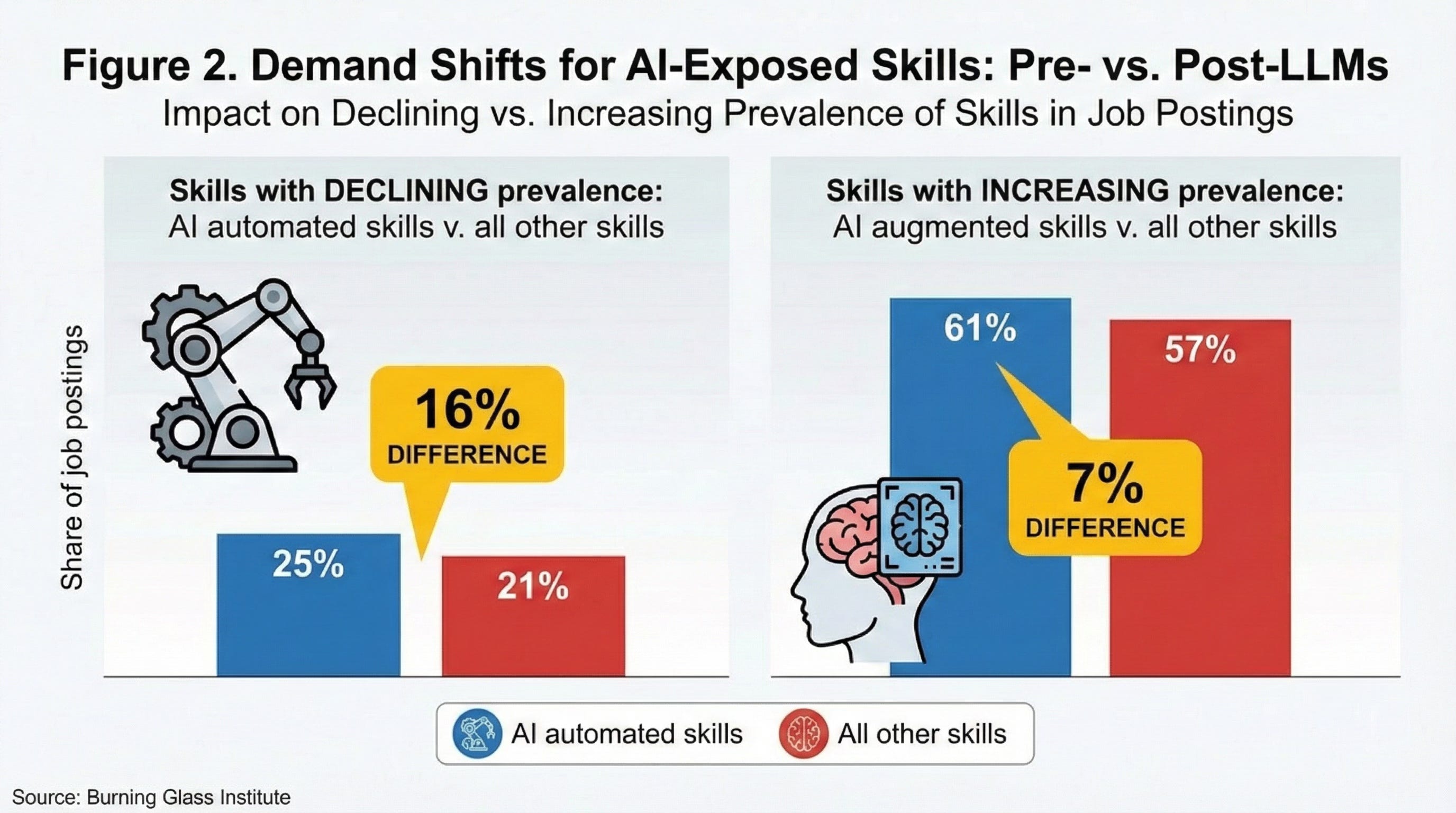
Skills that AI can replace were more likely to see demand drop. Skills that AI can amplify were more likely to see demand grow.
Looking at the left side of the chart: 25% of automation-exposed skills saw declining demand, compared to 21% of other skills. That 4-point gap means automation-exposed skills were about 16% more likely to decline. On the right side: 61% of augmentation-exposed skills saw growing demand, compared to 57% of other skills. That 4-point gap means augmentation-exposed skills were about 7% more likely to grow.
The gaps aren’t enormous. But the direction is consistent across occupations, and it showed up in just three years of data.
Here’s how the report frames it: the question isn’t “which jobs will survive?” The question is “how will this job change, and what new skills will workers need to perform it?”
Why This Reframe Matters
I think this finding is important because it shifts where the control sits.
If AI is coming to take your job, you’re stuck waiting to see what happens. You’re at the mercy of forces beyond your control. Maybe you update your resume. Maybe you try to guess which occupations will be safe. But fundamentally, you’re reacting.
If AI is reshaping the task mix inside your current role, that’s different. You can participate in that reshaping. You can pay attention to which parts of your work are becoming automated and which parts are becoming more valuable. You can have a say in what your job becomes.
One framing makes you passive. The other gives you something to do.
What the Research Doesn’t Tell Us
The Burning Glass report does offer guidance for workers, employers, and policymakers. They advise workers to track changes in their field, acquire skills where AI is creating demand, and double down on capabilities requiring judgment and context. They tell employers to think about role redesign, not just headcount reduction. They warn policymakers that the challenge isn’t relocating workers to “safe” occupations but helping them adapt as their current jobs transform.
This is solid advice. But I think there’s a layer underneath it that deserves more attention.
The report tells workers to “track the changes in your field” and “pay attention to how your own job is evolving.” That’s the right instinct. But how do you actually do that?
Here’s one way to start. Take your own job description, or a posting for a role you want, and use an AI to help you break down the task mix. Which of these tasks are becoming easier to automate? Which require more human judgment than before? Where is the value shifting?
You can do the same thing with your own weekly work. What did you spend time on? Which tasks could you hand off to AI right now? Which tasks require your specific knowledge, relationships, or judgment?
This kind of self-audit gives you a clearer picture of where you stand. And once you see the shape of the change, you can start building a runway for yourself. What skills do you need to develop? What parts of your work should you lean into? What relationships or knowledge give you an advantage that AI doesn’t have?
The same exercise works if you’re responsible for other people. Helping your team or your students see their own task mix clearly is the first step toward helping them prepare for what’s coming.

The Role of Human Agency
I believe there’s a variable that will determine who navigates this transition well and who doesn’t.
That variable is human agency.
Not AI skills. Agency. The capacity to direct intelligence that is not your own toward outcomes you have chosen.
Learning to use AI tools is straightforward. You can pick up the basics in an afternoon. But knowing which tool to reach for, and when, and why? Knowing what you’re trying to accomplish before you start prompting? Being able to tell when the AI output is good enough and when it’s wrong?
That’s harder. And that’s what separates people who use AI productively from people who just use AI.
I think of it as three related capabilities:
Intention. Knowing what you’re trying to accomplish before you reach for any tool. This sounds obvious, but it’s easy to skip. The clearer you are about your purpose, the better you can direct AI toward it.
Self-determination. Shaping how AI gets integrated into your work rather than accepting whatever default shows up. Someone is going to decide how AI fits into your job. It might as well be you.
Judgment. Discerning when AI output serves your purpose and when it doesn’t. AI is confident whether it’s right or wrong. You need to be the one who knows the difference.
These capabilities matter more than any specific tool or prompt technique. Tools change. The ability to direct them thoughtfully doesn’t go out of date.
What You Can Do
Let me get specific about what this means for different people.
If You’re a Professional
The question to ask yourself isn’t “Is my job safe?” That framing puts you in a passive position, waiting to find out your fate.
Ask instead: “How is my job changing?”
Look at your own work. Some of your tasks are probably getting easier. Faster to complete. Less dependent on your specific knowledge or judgment. Those are the parts that AI can take over, and in many cases, probably should.
Other parts of your work require more from you than ever. More context. More relationship. More thinking through tradeoffs that don’t have obvious answers. Those are the parts to pay attention to. That’s where your value is growing.
Your goal isn’t to protect your current set of tasks. Your goal is to participate in shaping what your role becomes. If you’re passive while your job changes around you, you might end up in a version of your role that you didn’t choose and don’t want.
One practical step: start noticing when you reach for AI and why. Are you using it to skip thinking, or to think better? There’s a difference. The first habit makes you dependent. The second makes you more capable.
If You Lead a Team or Organization
The obvious question is “Which roles can we automate?” I’d encourage you to ask a different one: “How should these roles change, and who’s going to design that?”
Role redesign is a design problem. It’s not just about efficiency. It’s about figuring out how humans and AI work together in a way that makes sense for your context.
The Burning Glass report flags something worth taking seriously. If you automate the entry-level tasks that traditionally built expertise, you create a pipeline problem. Junior employees learn by doing foundational work. That’s how they become senior employees. If AI handles all the learning-by-doing tasks, where do your future experts come from?
This isn’t a reason to avoid AI. It’s a reason to think carefully about how you introduce it.
One more thing: involve your people in the redesign. The workers doing the jobs understand which tasks benefit from human judgment and which don’t. They see nuance you won’t see from a distance. And if you design new workflows without their input, you’ll have a harder time getting their commitment to making those workflows succeed.
If You’re an Educator
The jobs our students are preparing for won’t look the same by the time they graduate. Not because the jobs will vanish, but because the task mix inside those jobs is already shifting. The Burning Glass data shows we can measure this shift now, just three years after ChatGPT launched.
Content knowledge still matters. But it’s not enough on its own.
We need to build human skills alongside the content. The Burning Glass report shows that skills requiring judgment, context, and relationships are seeing increased demand. Communication. Collaboration. Critical thinking. Ethical reasoning.
These have always mattered. Now we have data showing they matter more, not less, as AI becomes more capable.
But here’s the challenge: these are suitcase terms. They sound clear until you try to teach them. What does “critical thinking” actually mean in practice? What specific behaviors make up “collaboration”? These words carry a lot of cargo, and if we don’t unpack them, we end up with vague learning objectives that are hard to measure and harder to develop.
This is a time that calls for precision. If we’re going to help students build human skills, we need to get specific about what those skills actually are and how they show up in real work.
We also need to build human agency. Students need the ability to direct intelligence that isn’t their own. That’s what productive collaboration with AI actually requires.
This means helping students develop intention, so they can clarify what they’re trying to accomplish before they reach for any tool. It means building self-determination, so they shape how AI gets used in their work rather than accepting whatever default appears. And it means developing judgment, so they can tell when AI output serves their purpose and when it falls short.
We’re not preparing students for a destination that will stay fixed. We’re building their capacity to work with tools and systems that will keep evolving. The curriculum needs to reflect that. Not by dropping content, but by adding the human capabilities that make content knowledge useful when AI handles more of the routine work.
Where This Leaves Us
The Burning Glass report gives us something useful. Early evidence that AI’s impact on work is real, measurable, and more complicated than the simple stories we’ve been telling.
Jobs aren’t vanishing wholesale. They’re changing from the inside. Some tasks are getting automated. Others are getting amplified. Often in the same role, at the same time.
The question isn’t whether your job will exist in five years. The question is what your job will look like, and whether you’ll have a hand in shaping it.
That’s where human agency comes in. The ability to set your own intentions, to determine how you work with AI rather than having it determined for you, to apply judgment that the machine doesn’t have.
Building that capacity is the work in front of us. In ourselves, in our teams, in our students.
The transformation is already underway. The Burning Glass data confirms it. What we do next is up to us.
About the Author:
Todd McLees is co-Founder of humanskills.ai
External Links: Full Report:
Read the full Burning Glass Institute report: "Beyond the Binary: How Automation and Augmentation Are Combining to Reshape Work"